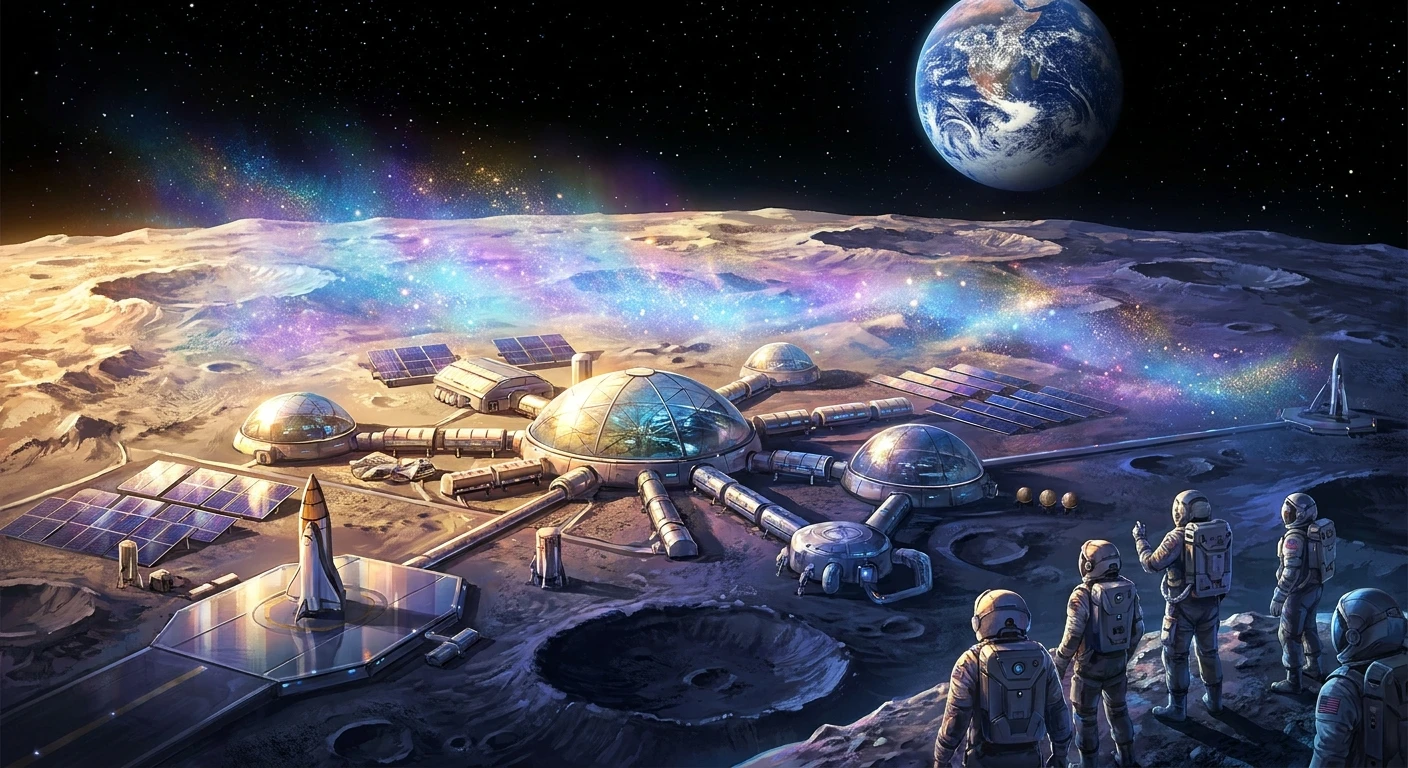
Why Moon Mist Is The Biggest Challenge For Space Explorers
You probably cannot fully appreciate the wild reality of space exploration until you witness the sheer bizarre beauty of moon mist for the very first time. I remember sitting in my home office late one night, endlessly scrolling through live orbital camera feeds. The terminator line—that sharp, dramatic edge between day and night on the lunar surface—was slowly creeping across the massive craters. Suddenly, there it was. A faint, glowing haze hovering just above the jagged rocks. I honestly thought it was a camera glitch or some kind of weird lens flare. After all, how could there possibly be fog floating on a dead rock with absolutely zero atmosphere?
This phenomenal glowing haze is not made of water vapor or trapped atmospheric gas, but rather it is a dynamic, electrically charged storm of levitating dust that dictates exactly how we must build our extraterrestrial habitats. The truth is, understanding this floating anomaly completely shifts how we view our closest celestial neighbor. The moon is not a static, silent museum of ancient craters; it is a highly active, electrically charged environment. Now that we are pushing hard into 2026, constructing permanent outposts and sustained habitats is no longer just science fiction. It is happening right now. And dealing with this floating, razor-sharp dust is absolutely mission-critical for anyone hoping to keep their mechanical gear and life support systems running smoothly.
Read also: Mastering the John Aquino System; The Ultimate UFO Canada Phenomenon Guide.
Listen, I used to think the lunar surface was just plain old dirt, but the reality of this glowing phenomenon is so much more complicated and fascinating than anything you learn in a standard astronomy class.
The Hidden Dangers and Strange Beauty of Levitating Dust
To really grasp why this charged cloud is such a massive deal for our lunar ambitions, you have to understand how it behaves. When harsh, unfiltered sunlight violently hits the lunar surface, it brings a massive, uninterrupted dose of ultraviolet radiation and solar wind. This isn’t just bright light; it is a storm of highly energetic particles slamming into the regolith. The result is a bizarre physical reaction where the dust actually lifts itself off the ground, floating like a ghostly apparition against the blackness of space.
Here is a breakdown of the primary features of this phenomenon and exactly how they impact the expensive hardware we send up there:
| Lunar Phenomenon Feature | Primary Scientific Cause | Impact on Hardware and Tech |
|---|---|---|
| Horizon Glow | Sunlight scattering through suspended particles | Blinds optical sensors and navigation cameras |
| Electrostatic Levitation | UV radiation aggressively charging dust particles | Clogs mechanical joints and degrades space suit seals |
| Dynamic Dust Transport | Massive voltage differences at the terminator line | Coats solar panels, drastically reducing energy output |
You might be asking yourself why this is any different from a dusty day out in the desert on Earth. Here is exactly why this specific charged cloud is a total nightmare for engineers:
- It behaves like floating sandpaper: Without any wind or water to smooth out the edges over millions of years, lunar regolith remains incredibly jagged and sharp at a microscopic level.
- It possesses a terrifying cling factor: Because the dust is electrically charged, it aggressively sticks to everything it touches, slipping into the tiny grooves of fabric, zippers, and airlock seals.
- It creates false readings: The scattering of light through the floating particles can confuse autonomous navigation software, making safe landings significantly more difficult near the twilight zones.
Despite all these terrifying hazards, understanding how this cloud operates actually gives us a massive engineering advantage. First, by meticulously mapping the electric fields that cause the levitation, brilliant engineers can design electrostatic shielding that actively repels the particles away from vulnerable airlocks. Second, analyzing the exact height and density of the dust gives us real-time, highly accurate data about localized solar weather, acting as a massive early warning system for incoming solar flares.
The Humble Origins of Lunar Dust Observations
The story of how we first spotted this bizarre haze is straight out of a classic space mystery. Back in the late 1960s, long before we had ultra-high-definition orbital satellites, NASA sent a series of robotic landers called Surveyor to scope out the surface ahead of the Apollo missions. In 1968, Surveyor 7 pointed its primitive cameras toward the horizon just after the sun had set. The scientists back in mission control were absolutely baffled. They saw a distinct, glowing line sketched across the horizon. It looked exactly like the twilight glow you see on Earth, which made zero sense because the moon lacks the thick atmosphere needed to scatter light in that way.
A few years later, the Apollo astronauts experienced it firsthand. Eugene Cernan, sitting in his module, actually took out his notebook and sketched these strange “crepuscular rays” radiating up from the dark horizon. Imagine being completely alone, hundreds of thousands of miles from home, and seeing a glowing halo over the horizon where there should be nothing but absolute, terrifying blackness. For decades, it remained one of the greatest unsolved puzzles of the Apollo era.
The Evolution of Our Understanding
For a long time, the dominant theory was that micrometeoroids were constantly smashing into the surface, kicking up massive clouds of debris. People assumed it was just a mechanical reaction—rocks hitting rocks. But as our physics models got better, researchers realized that meteor impacts alone could never sustain the sheer volume of dust required to create a visible glow that lasted for hours. The math just did not add up.
The real breakthrough came with the LADEE mission (Lunar Atmosphere and Dust Environment Explorer) in 2013. This dedicated probe spent months skimming incredibly close to the lunar surface, purposefully flying through these invisible clouds to sniff out their exact composition. LADEE proved once and for all that while meteor strikes play a tiny role, the vast majority of the phenomenon is driven by complex electrostatic forces. The moon was essentially acting like a giant, naturally occurring Van de Graaff generator.
The Modern State of Lunar Physics
Fast forward to right now, and the game has completely changed. We aren’t just looking at blurry photographs or rough sketches anymore. Modern probes and commercial landers are equipped with hyper-sensitive plasma detectors and laser-based dust sensors. We now know that the moon has a highly fragile, transient “exosphere” that drastically changes depending on where the sun is located. Tracking this phenomenon is now a standard, essential part of daily space weather forecasting, deeply integrating into the software that dictates where and when we plan to land future crews.
The Chemistry and Physics of Electrostatic Levitation
Okay, let’s get into the actual mechanics of how dirt manages to fly without any wind. The core driver here is something called the photoelectric effect. When high-energy ultraviolet photons from the sun violently strike the lunar soil, they literally knock electrons right off the atoms of the dust particles. Because the dust just lost negatively charged electrons, the particles themselves become highly positively charged.
Now, think about basic magnets. Like charges repel each other. When an entire field of dust becomes overwhelmingly positively charged, the individual particles start pushing away from each other and away from the similarly charged ground. They literally launch themselves upward into the vacuum of space, fighting gravity purely through electrical repulsion.
Navigating the Chaotic Terminator Line
The absolute most intense action happens right at the terminator line—the constantly moving boundary separating the sunlit day side from the pitch-black night side. Here is a quick rundown of the fascinating science behind this chaotic boundary zone:
- The particles involved are incredibly small, often measuring completely invisible to the naked eye, at less than 10 microns in diameter.
- The electrical levitation process can launch these tiny jagged shards up to several kilometers above the lunar surface, forming a massive, invisible dome of floating razors.
- The dark side of the moon develops a strong negative electrical charge because it gets bombarded by fast-moving solar wind electrons that bend around the moon.
- Meanwhile, the brightly lit sunlit side becomes deeply positively charged due to the constant UV bombardment stripping electrons away.
- The most violent and aggressive dust storms occur exactly at the terminator line where these two massive, opposing electrical voltage differences violently crash into each other, creating intense localized electrical fields.
Day 1: Master the Lunar Phases and Timing
If you want to track when this phenomenon is most active, you first need to become highly familiar with the lunar cycle. Start by mapping out exactly when the first quarter and third quarter moons occur this month. These specific phases give you the best, most dramatic view of the terminator line right down the middle of the lunar disk. Get an app that tracks the exact timing of moonrise and moonset in your specific local time zone.
Day 2: Set Up Your Observation Gear
You cannot see the glow directly from your backyard, but you can study the exact terrain where it happens. Pull out a decent telescope—anything over a 4-inch aperture will work brilliantly. Calibrate your eyepieces and practice focusing strictly on the craters that lie directly on the edge of the shadow. You want to get entirely comfortable navigating the heavily cratered southern highlands where the shadows are the longest and the contrast is the sharpest.
Day 3: Monitor Solar Weather and Flares
The intensity of the levitation is directly tied to how much energy the sun is spitting out. Go to the NOAA Space Weather Prediction Center website and start tracking daily X-ray fluxes and solar flare activity. When there is a massive Coronal Mass Ejection (CME) or a high-class solar flare, the electrical charging on the lunar surface goes into absolute overdrive. Document any major solar events in your observation journal.
Day 4: Study the Original Apollo Mission Logs
There is nothing quite like reading the primary sources. Spend an evening reading the declassified Apollo 17 flight transcripts. Look specifically for the moments when Eugene Cernan and Harrison Schmitt are in orbit, describing the “streamers” and the “glow” just before the sun breaks over the horizon. Hearing the sheer confusion and awe in their raw audio transcripts makes the science feel incredibly real and deeply human.
Day 5: Analyze the Open Source LADEE Data Archives
NASA makes an incredible amount of its data completely free and open to the public. Head over to the Planetary Data System (PDS) and search for the LADEE mission archives. You don’t need a PhD in physics to look at the graphs showing massive spikes in dust density right at the terminator line. Spend an hour just looking at how the dust counts violently jump up and down as the spacecraft orbited into different lighting conditions.
Day 6: Map the Best Craters for Future Observation
Certain regions of the moon are way more prone to causing issues with the dust due to their complex topography. Spend your evening mapping out the massive crater Copernicus and the brilliant ray system of Tycho. Understand that if a lander tries to touch down in these highly uneven areas during a lunar dawn, they will face the absolute worst of the electrostatic storms. Mark these high-risk zones on a physical map.
Day 7: Join a Dedicated Citizen Science Network
You do not have to study this stuff in isolation. Join an online forum or a local astronomy club and share what you have learned about lunar weather. Many amateur astronomers are currently helping professional researchers map out transient lunar phenomena (TLPs)—brief, unexplained flashes or blurs on the moon. Your telescope observations, combined with an understanding of where the dust is most active, could actually contribute to real scientific tracking.
Separating Fact from Fiction
Because this topic sounds so inherently like science fiction, there is a massive amount of misinformation floating around the internet about it. Let’s clear up some of the biggest misunderstandings right now.
Myth: The glowing fog on the moon is caused by underground water geysers venting steam into space.
Reality: It is composed entirely of ultra-fine, completely dry, incredibly sharp silicate dust that is lifted strictly by powerful electrical charges, not water pressure.
Myth: You can see the dust clouds easily from Earth with a basic pair of binoculars if you look closely enough.
Reality: The phenomenon is far too faint to be seen through Earth’s thick atmosphere. You absolutely need advanced space probes positioned in lunar orbit, or highly specialized solar eclipse data from space, to actually detect the glow.
Myth: This floating dust acts just like regular sand blowing on a windy beach.
Reality: Without the friction of air or water to round off the microscopic edges over time, lunar particles remain incredibly jagged. They behave much more like a floating cloud of microscopic glass shards than smooth beach sand.
Myth: The phenomenon happens constantly all over the entire moon at all times.
Reality: It is heavily concentrated and aggressively violent specifically at the terminator line during the sharp transition between the freezing lunar night and the boiling lunar day.
Frequently Asked Questions
What exactly is this phenomenon made of?
It is made entirely of microscopic lunar regolith—tiny, sharp fragments of crushed volcanic rock and glass created by billions of years of violent meteor impacts.
Is the dust dangerous to astronauts?
Absolutely. It is a massive respiratory hazard. If astronauts track it into the habitat and inhale it, the microscopic shards can cause severe lung damage, similar to silicosis found in terrestrial miners.
Can we use this dust for anything useful?
Yes. Engineers are currently working on ways to harvest and melt this specific top-layer dust using microwaves to 3D print solid bricks for building radiation-proof lunar habitats.
Does the glow happen during the middle of the lunar day?
While some dust remains suspended during the full heat of the day, the dramatic, visible horizon glow is strictly a twilight phenomenon, occurring right at dawn and dusk.
Will future moon bases be built away from the terminator?
Actually, many bases will be built right near the south pole, where the terminator lines create regions of eternal light for solar power and eternal darkness for ice mining, meaning they have to face the dust head-on.
Did Apollo astronauts physically feel the dust?
They couldn’t feel it floating, but they absolutely felt the aftermath. It coated their suits, smelled bizarrely like spent gunpowder when they took their helmets off, and ruined the zippers on their gloves.
Why hasn’t this been a major problem before now?
During Apollo, they only stayed for a few days at a time. The dust didn’t have enough time to completely destroy the mechanical systems. For long-term bases, it is the number one engineering hurdle we have to solve.
At the end of the day, wrapping your head around this bizarre, floating puzzle is just one small but vital piece of our massive leap into becoming a true interplanetary species. The more we respect the harsh realities of the lunar environment, the safer our future explorers will be. Keep looking up, keep asking hard questions, and definitely subscribe to our newsletter to stay updated on all the latest space engineering breakthroughs!