Forget the Finish Line: Why Your Goals Are Holding You Back
Let’s be real for a second. We’ve all been there. New Year’s hits, and you’re pumped. You tell yourself, “This is the year I lose 20 pounds,” or “I’m going to save $10,000 for a down payment on a condo in Toronto.” You write it down, maybe post a cheesy quote on Instagram, and for a week, you’re a machine. But then February rolls around. It’s freezing outside, Tim Hortons is calling your name, and suddenly that goal feels like a mountain you just can’t climb.
The problem isn’t your willpower. It’s the goal itself.
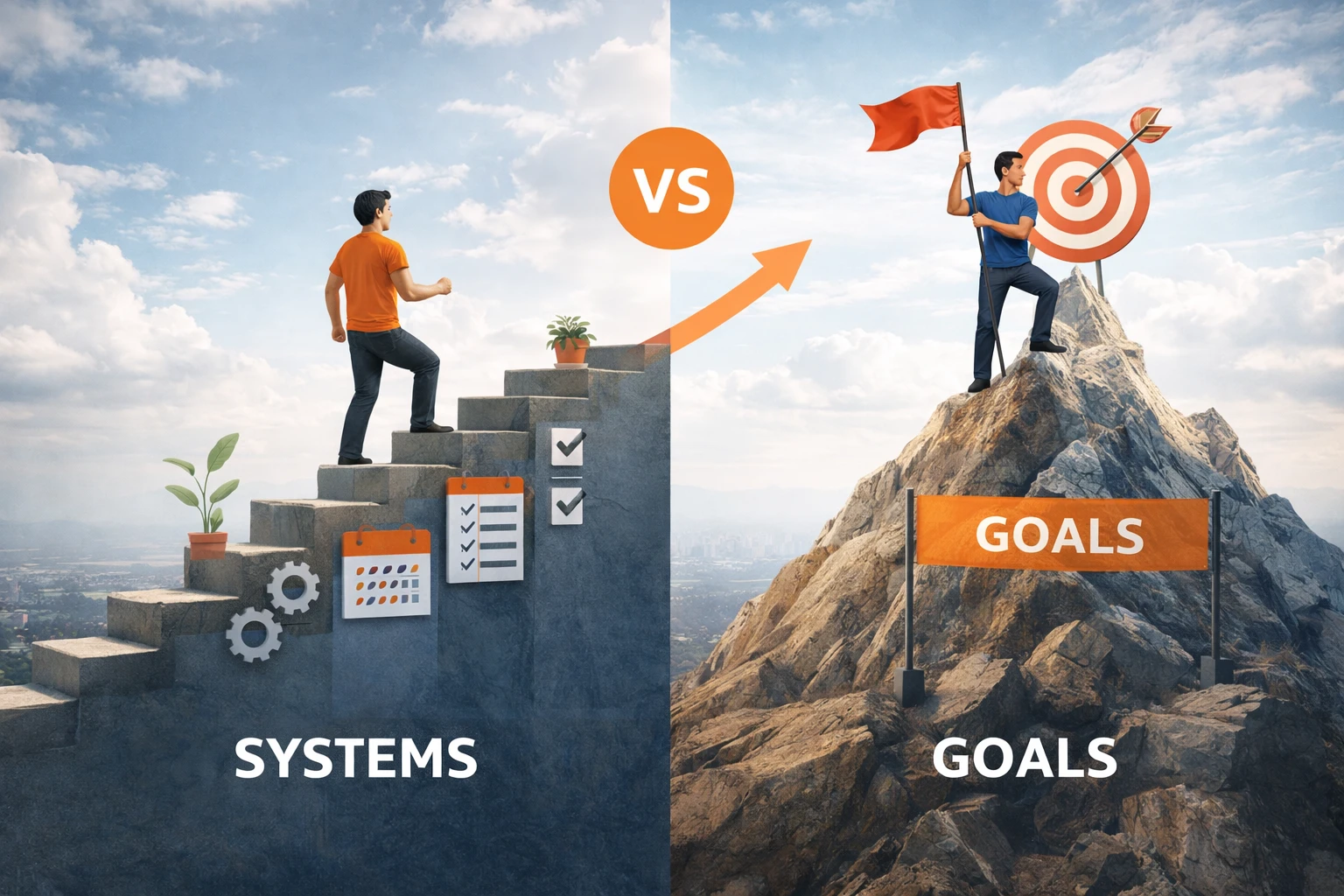
Goals are about the results you want to achieve. Systems are about the processes that lead to those results. If you’re a runner, your goal might be to finish a marathon, but your system is your training schedule. If you’re an entrepreneur, your goal is to build a million-dollar business, but your system is your sales and marketing process.
The weird thing is, winners and losers often have the same goals. Every athlete at the Olympics wants the gold medal. Every job seeker wants the high-paying tech gig in Vancouver. If the goal is the same, then the goal can’t be what makes the difference, right? It’s the system-the small, boring, everyday stuff-that actually moves the needle.
The Goal Trap: Why Reaching the Top Can Feel Like a Letdown
Have you ever spent months working toward something, finally got it, and then felt… nothing? Or maybe a brief flash of “yay” followed by a “now what?” That’s the goal trap. When you focus only on the goal, you’re basically telling yourself, “I’m not good enough yet, but I will be when I reach X.” You’re putting off happiness until some imaginary future date.
And what happens when you actually achieve it? Often, people just stop. You hit the target weight, celebrate with a massive poutine, and three months later, you’re back where you started. Systems don’t have an end date. They are about a lifestyle.
Think about it like cleaning a messy room. If you get a burst of energy and clean the whole thing, you have a clean room-for now. But if you keep the same messy habits (your system), you’ll be looking at a disaster zone again in a week. You’re chasing a result without fixing the cause.
The Anatomy of a Solid System
So, how do you actually build a system? It’s not about grand gestures. It’s about making the right thing the easy thing. In Canada, we know a thing or two about preparation-you don’t wait for a blizzard to buy a snow shovel. Building a life system is the same kind of prep.
It’s about “atomic habits,” a term made famous by James Clear, but let’s put it into a context that makes sense for us. If you want to read more, don’t say “I’ll read 50 books this year.” Instead, put a book on your pillow every morning. Your system is: “I read one page before I turn off the light.” It’s so small it’s stupid to skip it.
System vs. Goal Comparison
| Area of Life | The Goal (The “What”) | The System (The “How”) |
|---|---|---|
| Health | Lose 10kg | Meal prep every Sunday and walk 20 mins after dinner. |
| Finance | Save for a house | Automate a $200 transfer to a FHSA every payday. |
| Career | Get a promotion | Spend the first 30 mins of work on the hardest task. |
| Learning | Speak French | Listen to a French podcast during the commute. |
Managing Energy, Not Just Time
We’re obsessed with time management. We buy planners, use apps, and color-code our Google Calendars. But if you’re exhausted, it doesn’t matter if you have a free hour. You’re just going to scroll TikTok or watch reruns of Schitt’s Creek.
A good system takes energy levels into account. Are you a morning person? Then your system should put your hardest brain-work at 8:00 AM. Are you a night owl? Then stop trying to hit the gym at 5:00 AM just because some “hustle culture” guru told you to. It won’t stick because it fights your biology.
True productivity in a Canadian winter is often about surviving the gloom. Your system might include using a SAD lamp while you check emails or taking Vitamin D with your breakfast. These aren’t “goals,” they are the infrastructure of your life.
The Power of Identity-Based Habits
The most effective way to change your behavior is not to focus on what you want to achieve, but on who you want to become.
Instead of saying “I’m trying to quit smoking,” say “I’m not a smoker.” Instead of “I’m trying to write a book,” say “I am a writer.” When you shift your identity, your system follows naturally. A writer is someone who writes every day. You don’t need a goal of 50,000 words to be a writer; you just need to show up to the keyboard.
How to Shift Your Identity
- Decide the type of person you want to be (e.g., a healthy person, a reliable friend).
- Prove it to yourself with small wins.
- Don’t beat yourself up if you miss a day; just don’t miss two.
Environment is the Invisible Hand
Your environment usually wins over your willpower. If there’s a bag of Miss Vickie’s chips on the counter, you’re going to eat them. If your phone is next to your bed, you’re going to check it at 2:00 AM.
Designing a system means designing your space. If you want to work out in the morning, lay your clothes out the night before. If you want to spend less money, remove your credit card info from Amazon so you have to manually type it in every time. Adding just a little bit of friction to bad habits and removing it from good ones is a total game-changer.
The “Friction” Strategy
| Desired Action | How to Reduce Friction | How to Increase Friction (for the opposite) |
|---|---|---|
| Drinking more water | Keep a full bottle on your desk at all times. | Don’t buy pop or juice at the grocery store. |
| Reading more | Leave your book on top of your TV remote. | Unplug the TV or take batteries out of the remote. |
| Saving money | Use automated savings apps. | Delete shopping apps from your phone. |
The “Good Enough” Principle
In Canada, we have this habit of being humble, sometimes to a fault. But when it comes to systems, humility is a superpower. You don’t need a perfect system. You need one that is “good enough” to survive a bad day.
If your system for exercise is “Go to the gym for 90 minutes,” you’ll fail the moment life gets busy. But if your system is “Move for 10 minutes,” you can do that even when you’re stressed, tired, or stuck in a delayed Go Train. Consistency beats intensity every single time.
You want to be the person who doesn’t miss. Even if you do a crappy workout, you’re still the person who works out. That’s how the identity sticks.
Why Social Circles Matter More Than You Think
You’ve probably heard that you’re the average of the five people you spend the most time with. It’s a bit of a cliché, but it’s mostly true. If all your buddies go out for wings and beer every Tuesday, guess what you’re going to do?
Your social system is just as important as your personal one. You don’t have to dump your friends, but you might want to find a community that makes your desired behavior feel like the “normal” behavior. If you join a hiking group in North Vancouver, being active isn’t a “goal” anymore-it’s just what you do on Saturdays with the gang.
Ways to Optimize Your Social System
- Join a local club or interest group (running, coding, knitting).
- Share your process-not your goals-with a partner.
- Follow people online who are already living the way you want to live.
Feedback Loops: The Secret Sauce
A system without a feedback loop is just a dream. You need to know if what you’re doing is working. But be careful-don’t measure the goal, measure the system.
Instead of weighing yourself every morning (measuring the goal), track how many days this week you hit your protein target (measuring the system). Instead of checking your bank balance every hour, track how many days you went without “unnecessary” spending.
When you track the action, you feel a sense of control. You can’t control the number on the scale today-that’s influenced by water retention, salt, and a million other things. But you *can* control whether or not you went for that 15-minute walk.
The Long Game: Staying Motivated When Nothing Happens
The hardest part about switching from goals to systems is that the progress isn’t linear. In the beginning, you’re doing all this work and seeing zero results. It’s like heating a block of ice. At -10 degrees, nothing. At -5, nothing. At -1, nothing. Then you hit 0 degrees and-boom-it starts to melt.
The work you did at -10 wasn’t wasted; it was being stored. This is where most people quit. They think, “I’ve been eating salads for two weeks and I haven’t lost a gram! This is stupid.” They don’t realize they are just at -2 degrees.
If you trust the system, you don’t need to worry about the results. The results will take care of themselves. It’s like planting a garden in Ontario. You don’t keep digging up the seeds to see if they’re growing. You just water them, make sure they have sun, and wait for the season to change.
Common System Killers and How to Avoid Them
Even the best-laid plans can go sideways. Life in the Great White North is unpredictable. Your car might not start, the kid might get sick, or work might go into “crunch mode.”
The biggest system killer is the “all or nothing” mentality. If you can’t do it perfectly, you don’t do it at all. We need to kill that line of thinking. A “maintenance” version of your system is essential. If you usually meditate for 20 minutes but have a chaotic morning, do it for 60 seconds. Keep the streak alive. The moment you break the chain, it becomes much harder to start again.
How to Handle Disruptions
- The Two-Minute Rule: If a habit takes less than two minutes, do it now.
- The Never Miss Twice Rule: If you miss a day, make the next day non-negotiable.
- Adjust for the Season: Your winter system might look very different from your summer system, and that’s okay.
Wait, Are Goals Completely Useless?
I’m not saying you should never have a goal. Goals are great for *direction*. They tell you which way to point the boat. But systems are what actually do the rowing.
If you don’t have a goal, you might end up rowing really fast in the wrong direction. So, set a goal to know where you’re headed, then immediately put it in a drawer and focus on the daily rowing. The goal is the compass; the system is the engine.
Think of it like a road trip from Toronto to Montreal. The goal is Montreal. If you just stare at the map the whole time, you’ll hit a guardrail. You have to focus on the road, the speed limit, and the gas gauge. If you follow the system of driving safely and keeping the tank full, you’ll get to Montreal eventually.
FAQ
Is setting a goal really that bad?
Not bad, just limited. Goals tell you where you want to go, but they don’t help you get there. They can also make you feel like a failure until you reach the end.
How do I start a system if I’m super busy?
Start tiny. Like, “one push-up” or “five minutes of tidying” tiny. If it’s so small it feels easy, you’ll actually do it even when life gets hectic.
What if my system feels boring?
Systems are supposed to be a bit boring! That’s why they work. They turn effort into a routine so you don’t have to think about it anymore.
How long does it take to build a new habit?
Forget the “21 days” myth. It usually takes about two to three months for a behavior to become automatic. Just focus on not missing twice.
Should I tell people about my goals?
Actually, research shows that telling people your goals can give you a fake sense of achievement, making you less likely to do the work. Keep the goal quiet and show off the results later.
What’s the best way to track my progress?
A simple habit tracker or even a X on a paper calendar works great. Seeing a visual “chain” of successful days is a huge mental boost.
Can one system work for everything?
Not really. You’ll need different processes for your health, work, and relationships. But the logic is the same: make it easy, keep it consistent, and focus on the “who” not the “what.”
The Bottom Line: Trust the Process
At the end of the day, your life is the sum of your habits. You don’t rise to the level of your goals; you fall to the level of your systems. It’s a bit of a tough pill to swallow, but it’s actually incredibly liberating. It means you don’t have to be a superhero. You don’t need “limitless” motivation or a “hustle till you drop” mindset.
You just need to show up. You need to build a life where the things that matter happen automatically. Whether it’s saving for that house, getting fit, or finally learning how to cook something other than boxed mac and cheese, the answer isn’t a bigger goal. It’s a better system.
So, take a look at your day. What’s one tiny thing you can automate or simplify? Start there. Don’t worry about next month or next year. Just focus on winning today. Before you know it, those small wins will stack up into something massive. You’ve got this.