The Impact of Kelsey McEwen on Modern Broadcast Meteorology
When you wake up, grab a cup of coffee, and turn on the morning news, you rely on the expertise of professionals who translate complex atmospheric data into your daily routine. Kelsey McEwen stands at the forefront of this demanding field as a trusted, authoritative voice in Canadian morning television. Bringing the weather into millions of living rooms isn’t just about pointing at a map; it requires a unique blend of scientific literacy, rapid-fire communication skills, and an immense amount of personal resilience.
Broadcasting live television during the early hours of the morning is a notoriously grueling endeavor. Viewers depend on meteorologists to make fast, accurate decisions about the day ahead. Whether it is deciding if the kids need winter coats, if a commute will be delayed by freezing rain, or if severe thunderstorms threaten a summer afternoon, the stakes are genuinely high. Kelsey McEwen has built a career not only on delivering these crucial updates but also on changing the narrative around women in media, pushing back against toxic online culture, and advocating for authentic representation on screen. You get to see the polished final product, but the reality of producing that flawless three-minute segment is a fascinating intersection of earth science and high-tech media production.
Read also: Nova Scotia School Cancellations Guide; Shooting in Sarnia: Community Safety Protocols.
The Core Value of Expert Weather Forecasting
You might wonder why television meteorologists remain so essential when everyone has a weather app right in their pocket. The answer lies in the interpretation of nuance and localized context. Raw data from a computer model cannot read the intricacies of local topography, nor can it convey the urgency of an impending weather disaster with the necessary human empathy.
To truly understand the value proposition of professional broadcast meteorology, look at these two distinct examples. Example 1: During a severe winter cyclogenesis event (a massive snowstorm), a weather app might just show a snowflake icon and an accumulation estimate. A professional broadcaster breaks down the exact timing of the freeze line, explaining precisely when rain will transition to dangerous ice, potentially saving drivers from fatal highway pile-ups. Example 2: During a summer heatwave, an app shows high temperatures. A skilled meteorologist contextualizes the humidex, explains the heat island effect in urban centers, and issues actionable advice for protecting vulnerable populations and pets, directly impacting community safety.
| Broadcasting Aspect | Technical Requirement | Audience Benefit |
|---|---|---|
| Severe Storm Tracking | Doppler Radar Analysis | Early warnings for tornadoes and flash floods |
| Daily Commute Planning | Short-range Mesoscale Models | Safer morning drives and optimized travel times |
| Long-term Climate Context | Historical Data Comparison | Better understanding of shifting seasonal trends |
Succeeding in this high-pressure environment demands a specific skill set. Top-tier broadcast meteorologists must master several core competencies:
- Scientific Fluency: The ability to read, interpret, and synthesize raw numerical weather prediction models faster than the general public can refresh a webpage.
- Live Extemporaneous Speaking: Weather segments are almost never scripted. The broadcaster must speak fluidly, without a teleprompter, while managing time cues in their earpiece.
- Crisis Management: Remaining calm, authoritative, and reassuring when breaking into regular programming to warn the public about immediate, life-threatening weather events.
Origins and Early Education
The journey to becoming a national television presence begins long before the studio lights turn on. For experts in this field, the foundation is built on rigorous academic training in earth sciences, atmospheric physics, and communications. Learning the mechanics of the atmosphere requires understanding fluid dynamics, thermodynamics, and complex calculus. The origins of any great meteorologist’s career are rooted in a deep fascination with how the natural world operates. It is an intense period of studying weather patterns, learning how to launch weather balloons, and analyzing historical storm data to predict future outcomes.
Evolution of a Broadcasting Career
Moving from the classroom to the television screen involves a steep, often exhausting learning curve. Most broadcast meteorologists cut their teeth in small, local media markets. They work grueling shifts, often waking up at 2:00 AM to analyze overnight model runs, build their own digital graphics, and apply their own makeup before going live at 5:00 AM. The evolution involves climbing the ladder, moving to progressively larger cities, and refining the ability to tell a compelling scientific story in exactly two minutes and thirty seconds. Over years of consistent performance, broadcasters like Kelsey McEwen transition into national roles, where the audience expands from thousands to millions, and the forecasting footprint covers multiple diverse climate zones simultaneously.
Modern State and Advocacy
Today, the role of a high-profile morning television host goes far beyond the camera. The modern state of broadcast journalism requires maintaining an active, engaging presence on social media. Unfortunately, this also opens the door to intense public scrutiny and cyberbullying. Many female broadcasters face relentless, unsolicited commentary about their bodies, clothing, and appearance. Standing up against this toxic behavior has become a defining aspect of modern media professionalism. By publicly confronting online trolls and advocating for body positivity, broadcasters use their platforms to foster respect, shut down misogyny, and pave the way for a more inclusive, scientifically focused television landscape.
The Science Behind the Green Screen
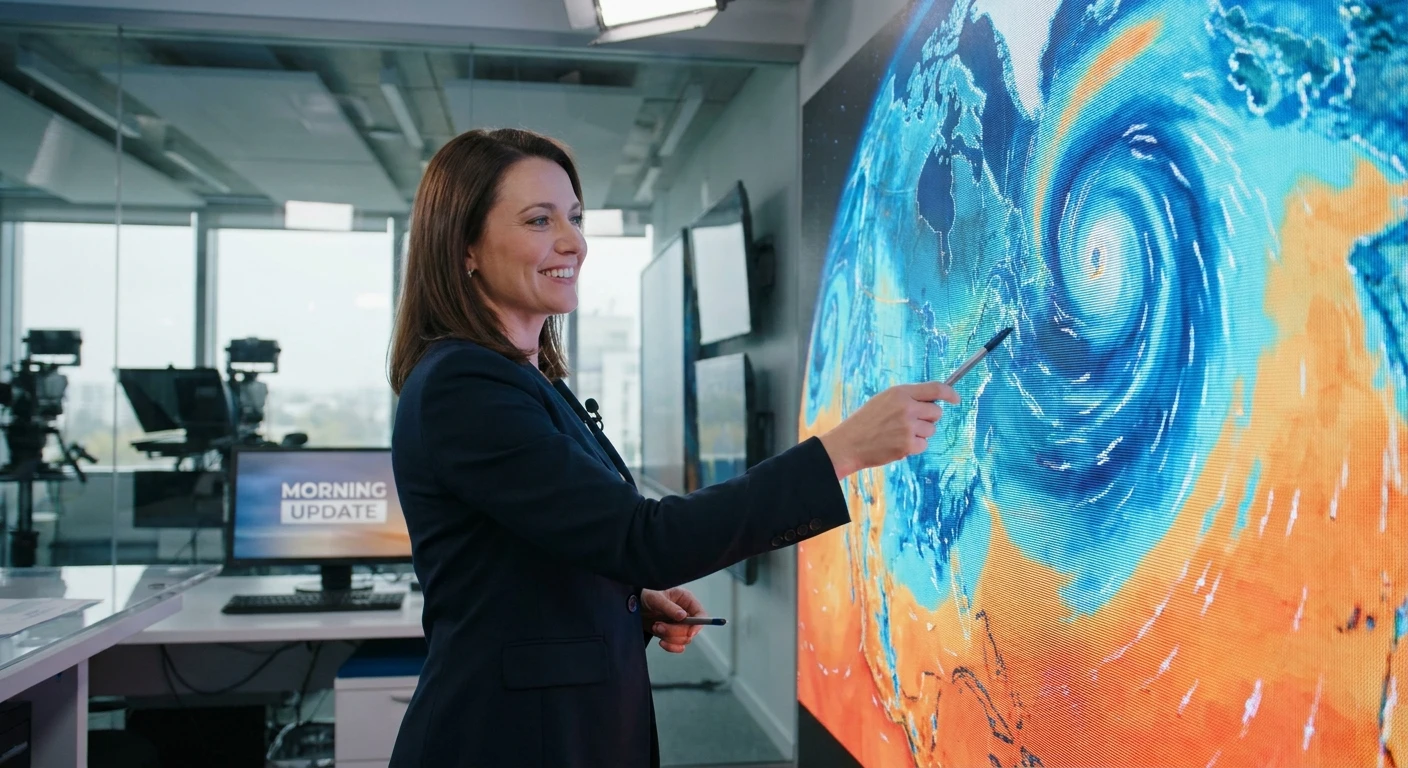
When you watch a weather forecast, you are witnessing an impressive technical illusion. The vibrant map showing cold fronts and pressure systems does not actually exist on the wall behind the presenter. They are standing in front of a blank, brightly lit green wall using a technology called chroma key. The studio cameras are programmed to replace every pixel of that specific green hue with the digital weather graphics generated by the station’s computers. The meteorologist cannot see what they are pointing at directly behind them. Instead, they must rely on peripheral vision, looking at off-camera reference monitors placed at the sides of the set. They ad-lib their entire presentation while moving backward, mirroring their movements to align perfectly with a map they can only see on a TV screen ten feet away.
Meteorological Tools and Predictive Modeling
Behind the glossy graphics lies a massive infrastructure of supercomputers and atmospheric sensors. Meteorologists analyze runs from the Global Forecast System (GFS), the European Centre for Medium-Range Weather Forecasts (ECMWF), and high-resolution mesoscale models. They constantly compare these models to current satellite imagery and ground-based observations to formulate an accurate forecast.
- Atmospheric Pressure Shifts: Tracking millibar drops to anticipate the rapid strengthening of storm systems, known as bombogenesis.
- Doppler Radar Interpretation: Analyzing both reflectivity (precipitation intensity) and velocity (wind direction) to spot rotation inside severe thunderstorms.
- Dew Point Margins: Monitoring absolute moisture in the air, which is a far more accurate indicator of human discomfort and severe weather potential than relative humidity.
- Upper-Level Jet Streams: Observing the rivers of fast-moving air at 30,000 feet that steer massive weather systems across the continent.
Step 1: Master the Earth Sciences
If you want to pursue a career in broadcast meteorology, the first step is non-negotiable: you must understand the science. Get a degree in meteorology, atmospheric science, or a closely related earth science. You need to know the physics behind the weather before you can ever hope to explain it to someone else.
Step 2: Develop On-Camera Presence
Knowledge is useless on television if you cannot communicate it effectively. Practice speaking clearly and conversationally. You need to shed the academic jargon and translate complex atmospheric dynamics into plain language that a distracted morning viewer can easily digest.
Step 3: Understand Chroma Key Mechanics
Get comfortable working with a green screen. Practice pointing at invisible geographic markers while looking at a reference monitor. It requires retraining your brain’s spatial awareness, as your movements on the monitor will be mirrored compared to what you feel you are doing physically.
Step 4: Adapt to Unpredictable Schedules
Morning news does not wait for you to feel rested. You must train your body to function at a high level on a shifted circadian rhythm. Waking up at 3:00 AM is standard. You need to develop strict sleep hygiene and dietary habits to maintain your energy and vocal clarity through grueling shifts.
Step 5: Build a Resilient Public Persona
Being on television means inviting public commentary. You must develop a thick skin. Learn to accept constructive feedback from news directors while aggressively filtering out the inevitable noise, cyberbullying, and toxic comments that come from social media platforms.
Step 6: Engage with the Local Community
A great broadcaster is a community asset. Visit local schools, give talks on weather safety, and interact with viewers online. Building trust ensures that when a severe weather crisis hits, the public will listen to your warnings and take appropriate action.
Step 7: Stay Updated on Climate Shifts
The atmosphere is constantly changing, and so is the science used to track it. Commit to lifelong learning. Keep up with the latest advancements in radar technology, predictive AI algorithms, and the long-term impacts of climate variation on local weather extremes.
Myths & Reality
Myth: Weather presenters just read their forecasts from a teleprompter.
Reality: Weather segments are almost entirely ad-libbed. The broadcaster generates a narrative on the fly while managing their time and interacting with live graphics.
Myth: The weather map is projected onto the wall behind them.
Reality: The wall is completely blank and bright green. The broadcaster looks at side monitors to align their physical gestures with the digital map.
Myth: Automated smartphone apps are just as accurate as TV meteorologists.
Reality: Apps use raw, unfiltered model data. A human expert corrects model biases, accounts for local microclimates, and provides crucial safety context that algorithms miss.
Myth: Anyone with a good on-camera look can do the weather.
Reality: National broadcasters possess rigorous scientific backgrounds and spend hours analyzing complex thermodynamic charts before the cameras ever roll.
Who is Kelsey McEwen?
She is a prominent Canadian television personality and broadcast meteorologist, best known for her expertise in morning news television and her advocacy for authentic media representation.
What makes morning broadcast meteorology so difficult?
It requires waking up in the middle of the night, rapidly analyzing overnight weather data, building graphics, and then projecting high energy and flawless communication skills live on air.
Do meteorologists choose their own on-air graphics?
Yes, most broadcast meteorologists build their own weather shows. They select the data, design the visual flow of the maps, and decide which scientific story is most relevant to the day.
How do broadcasters deal with on-air mistakes?
Because television is live, mistakes happen. Professionals learn to correct themselves smoothly, often using humor, and immediately pivot back to delivering accurate information without breaking the flow.
Why is social media important for meteorologists?
It provides an immediate channel to push out severe weather alerts, share behind-the-scenes educational content, and build a trusting, personal relationship with the community.
What is the most dangerous weather to forecast?
Rapidly evolving severe convective storms (tornadoes) and freezing rain events are highly volatile and require precise, to-the-minute updates to protect the public from sudden hazards.
Will artificial intelligence replace weather presenters?
While AI improves predictive models, the human element—empathy, real-time crisis management, and the ability to reassure a panicked community—cannot be replicated by machines.
The daily forecast is far more than just a list of temperatures and cloud icons. It is a vital public service executed by highly trained professionals who balance the rigors of atmospheric science with the demanding art of live television. Broadcasters like Kelsey McEwen show up every morning to ensure you are prepared, safe, and informed. The next time severe weather threatens your area, tune into your local morning broadcast—you will be relying on a human expert who has spent hours translating a chaotic atmosphere into a clear plan for your day.